
What If One of the Most Productive Parts of Your Day Happens When You’re Not Trying to Be Productive?
Shower University is a funny, practical book about creating better ideas, solving problems, capturing inspiration—and turning more of what you think about into something you actually do.

Have you ever stepped into the shower thinking about one thing—or nothing at all—and suddenly had the answer to a problem you’d been wrestling with for hours?
Maybe it was a business idea. A better way to organize something. The missing piece of a project. A new offer. A solution to something that had been slowing you down. Or just one of those thoughts that makes you stop mid-shampoo and say, “Wait. That’s actually good.”
That moment is the starting point for Shower University.
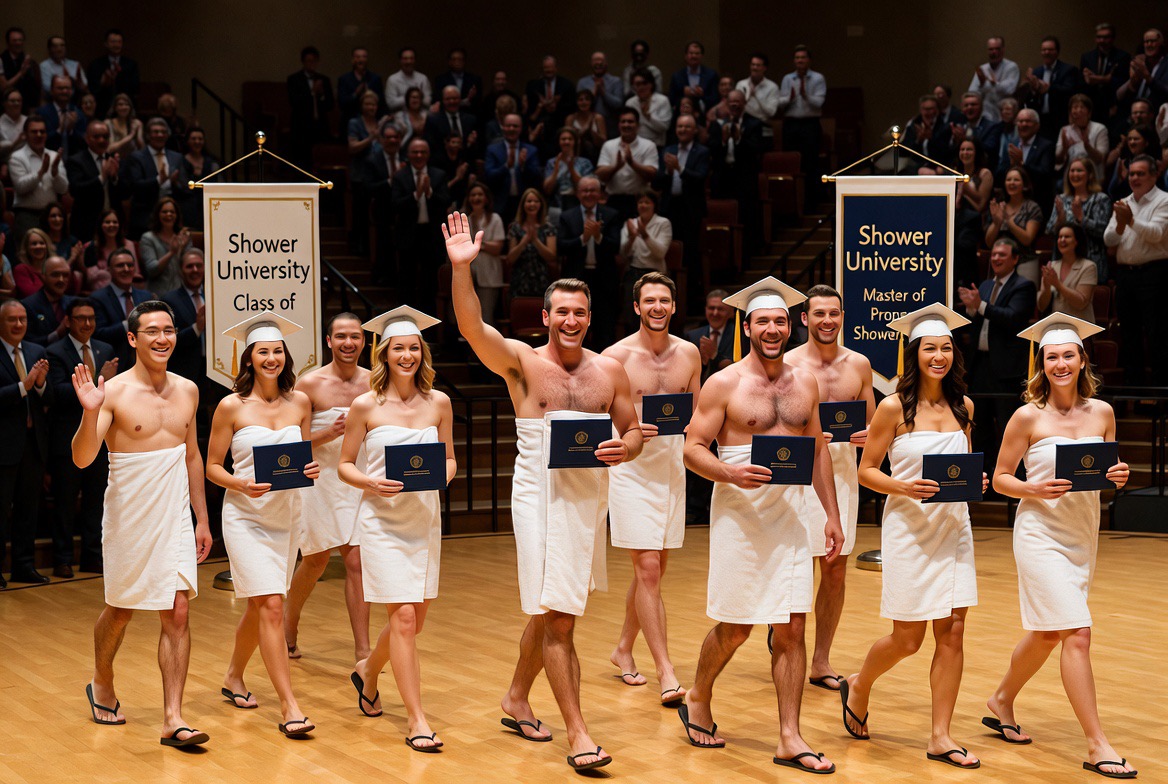
To make that simple idea more memorable, we built a completely fictitious university around the concept. The campus, the faculty and the academic humor are part of the fun—but the thinking behind it is practical.
Think of Shower University as the place where the idea lives. This book is your textbook. It is designed to help you become more productive, more creative and much better at capturing useful ideas before they disappear.
But this is not really a book about showers.
It is a book about productivity. Not the kind that tells you to cram another 17 tasks into your day. The kind that helps you think more clearly, generate better ideas, solve problems, notice opportunities, capture what matters, and move useful thoughts into action.
Being busy is not the same thing as being productive. Sometimes the smartest thing you can do is give your brain enough room to think.
Your Brain Needs More Than a To-Do List
Modern productivity usually starts with calendars, lists, reminders, apps and schedules. Those things matter. But none of them can do the thinking for you.
If you are working on the wrong problem, executing a weak idea, overlooking a better solution, or constantly reacting to interruptions, getting things done faster does not necessarily get you where you want to go.
Real productivity also means knowing what deserves your attention.
That is where the strange little magic of the shower becomes useful. For a few minutes, the notifications stop. You are not answering emails. You are not scrolling. You are not in a meeting. You are not multitasking.
Your mind finally gets some breathing room.

The book explores why that mental space matters and how you can create more of it—not just in the shower, but in the rest of your life too.
Productivity Starts Before You Do the Work
Before you execute, you have to think. Before you solve, you have to notice the problem. Before you create something valuable, you need the idea—or at least the question that leads you toward it.
Shower University helps you become more intentional about that part of the process.

- Recognize when and where your clearest thinking tends to happen.
- Create more mental breathing room instead of filling every quiet moment.
- Ask better questions that lead to better answers.
- Generate more possibilities instead of waiting for one perfect idea.
- Capture useful thoughts before they disappear.
- Improve ideas instead of expecting them to arrive fully formed.
- Test possibilities and move the best ones toward action.
That is productivity at a deeper level: less wasted thinking, fewer lost ideas, better decisions and more meaningful action.
How Many Good Ideas Have You Already Lost?
You know how it happens.
You get a great idea. You tell yourself you’ll remember it. It feels too good to forget.

Then real life shows up.
You get dressed. Check your phone. Answer a message. Start breakfast. Jump into work.
Twenty minutes later, the idea is gone.
One of the chapter titles in the book says it perfectly:
Capturing Lightning Before It Goes Down the Drain
Because having a good idea is not enough. A productive idea has to survive long enough to be examined, improved and acted on.
A useful idea is only useful if you capture it.
Creativity Is Not a Personality Type
A lot of people quietly decide they are “not creative.” They leave creativity to artists, writers, musicians, inventors and the people who supposedly have that kind of brain.
But creativity is also what happens when you find a better way to do something, connect two ideas, solve a stubborn problem, simplify a process, see an opportunity, or ask a question nobody else thought to ask.

That is why one of the core ideas in the book is simple:
Creativity is a skill, not a gift.
Skills improve when you use them. The more often you generate possibilities, ask questions, capture ideas and experiment with them, the less you have to depend on random inspiration.
And Now We Have AI. That Makes Your Thinking More Important, Not Less.
We live in a time when AI can help brainstorm, organize information, expand an idea, challenge assumptions, summarize material and help you move faster.
But every tool still needs a starting point.
A useful question. A problem worth solving. An observation. A spark. An idea.
The ability to notice those things—to think clearly enough to know what deserves attention—has become even more valuable.
AI can help you work with an idea. It cannot make you pay attention to your own life for you.
A Look Inside the Book
This is not a collection of generic motivational slogans. The book takes the shower idea and uses it as a practical doorway into creativity, productivity, problem-solving and action.
Among the chapter ideas you’ll encounter are:
- The World’s Most Overlooked Classroom
- The Clean Mind Effect
- The Art of Asking Better Questions
- Creativity Is a Skill, Not a Gift
- The Entrepreneur’s Shower
- The Innovation Rinse Cycle
- Capturing Lightning Before It Goes Down the Drain
- The Shower Lab
- The Science of Solitude
- Creativity Beyond the Shower
You’ll also encounter exercises and prompts designed to help you generate ideas, ask better questions, capture them, improve them and decide which ones deserve action.
Meet the Man Behind Shower University: Dr. Leonard Moist
Of course, if you are going to build a fictitious university around better thinking, productivity, creativity and those strange flashes of inspiration that seem to show up under running water, you need a founder.
Enter Dr. Leonard Moist—bathing innovator, academic visionary and, according to university history, the man who founded Shower University in 1987 with a mission to elevate an ordinary daily routine into something far more useful.
Legend has it that the original idea began after Dr. Moist misplaced a notebook and spent three days looking for it. During a routine morning shower, the answer suddenly came to him: the notebook was not actually lost. It was sitting exactly where he had left it.
Unfortunately, he still could not remember where that was.
It was eventually discovered in the refrigerator next to a jar of pickles.
That episode did not solve the notebook problem in the shower, but it did spark a much more interesting observation: people often think differently when the noise drops away and the mind is given room to wander.
From there, the legend of Shower University grew. Dr. Moist went on to become associated with such distinguished academic pursuits as steam sciences, hydro-performance research, towel efficiency studies and the groundbreaking field of rotational loofah efficiency. His original thesis, Steam and Human Potential, became part of university lore, and he eventually received the institution's highest honor—the Golden Loofah Award for Excellence in Steam Sciences.
Yes, it is ridiculous.
That is exactly the point.
The humor makes the idea memorable. But underneath the fictional professor, the research departments and the academic nonsense is something very real: when you create space to think, ask better questions, capture what shows up and take action on the useful ideas, you can become more creative and more productive.
That is why the university exists inside the book. It gives a serious idea a personality—and makes the lessons a whole lot harder to forget.
The Goal Is Not More Ideas. The Goal Is More Useful Ideas.
There are people with notebooks full of ideas they never touch again.
That is not the point.
The point is to get better at recognizing the thoughts that deserve a second look.
One simple idea in the book is the Five-Idea Challenge. Instead of putting pressure on yourself to come up with one brilliant answer, generate five possibilities. They can be incomplete. Imperfect. Weird. Even bad.
Because idea number one often leads to number two. Number two changes number three. Then number five suddenly makes you think, “Now that could work.”
Another concept is your Idea Vault: one place where potentially useful thoughts can live long enough to be revisited.
And then there is the Innovation Rinse Cycle: simplify, improve, expand and repeat. Instead of waiting for a perfect idea, you learn to make a promising one better.
That Is Where Productivity and Creativity Meet
Productivity is not just checking boxes. Creativity is not just dreaming.
The real leverage happens when the two work together.
You notice a problem. You generate possibilities. You capture the idea. You improve it. You test it. You do something with it.
That can apply to a business, a project, a piece of content, a personal goal, a new source of income, a family problem, a process that wastes your time, or something you have wanted to create for years.
Good thinking makes action more productive. Action makes good thinking valuable.
You Do Not Need Another Reason to Be Busier
You probably already have plenty to do.
What you may need is a better way to think about what you are doing.
A way to recognize good ideas sooner. To stop losing them. To ask questions that open up better answers. To protect a little quiet thinking time. To improve an idea instead of abandoning it because the first version is not perfect.
That is the promise behind Shower University.
Not that every shower will produce a breakthrough.
But that you can become better at creating the conditions where useful thinking happens—and better at doing something when it does.
Your next productive breakthrough may not begin at your desk. It may begin when your mind finally has enough room to wander.
One Last Question
Tomorrow morning, you may step into the shower and suddenly think of a better way to do something.
A problem may finally make sense.
A new opportunity may occur to you.
Or an idea you have been circling for months may suddenly click.
What will you do with it?
Order Shower University Today

The Tool I Use to Capture Ideas When They Show Up
I used to rely on my phone to capture ideas before they disappeared. Now I use Pocket. When a useful idea shows up, I want to capture it before the rest of the day pushes it out of the way.
Affiliate disclosure: If you purchase through this link, I may receive a commission at no additional cost to you.
Shower University is about what happens when you stop filling every quiet moment—and start paying attention to what your mind has been trying to tell you.